Welcome to Bond Graph Component's Models
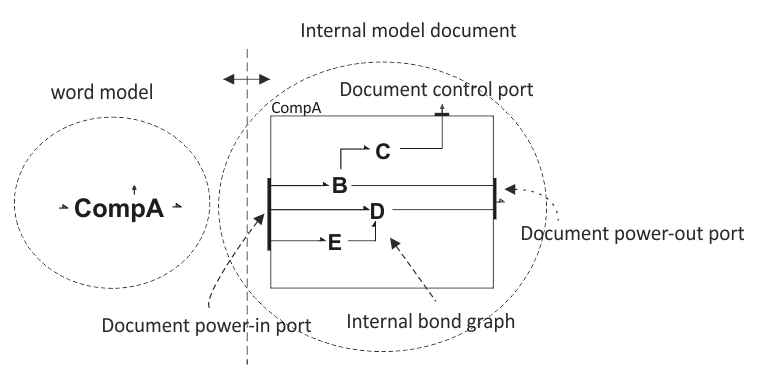
To model a real component we may look at it from the outside or inside (Figure 1.). Looking from the outside we represent it with the corresponding word model. The component's word model consists of its name or title, and the ports inserted in the strip around the title (Figure 1. left), which models its interaction with component's environment. There are two types of the ports: power ports and control or signal ports. The first one models the interactions with its environment, which are characterized by transfer of power into or outward of the component. They are represented by half-arrows, which are in a way the trademark of the Bond Graphs. The directions of the half-arrows show assumed positive direction of the power transfer. The control ports are borrowed from Control Engineering. The input port serves for transfer of the signals into the component, and output ports similarly for extraction of the signals from the component.
To find its internal structure we have to "open" the component . By openning a component we represent its internal structure by a document, which is bounded by a rectangle (Figure 1. right). On the outside edges of this rectangle, there are the narrow strips, which lies on the same side as the corresponding the component ports and represent the document's (internal) ports. Every internal component that the component contains we represent by corresponding word model. If the internal components are interacting we connect their interacting ports with line known as bond line or short bond. If internal component is interacting with some outside component, we connect it to the corresponing document port. Thus, power or signal information is transferred from outside by a word component's port and then through the corresponding document ports into a component connected to it. Similarly holds for transfer from inside components to the outside world. The diagram composed of these internal components and bonds represent internal bond graph and describes the internal dynamic of the component.
Hence, the model of a component is composed of two parts:
• Word Model, which serves
as the component header,
• Component's document, which contains the internal Bond Graph model
.